
Radon Fan Replacement in Wentzville MO: Signs Your System Isn’t Working Properly
- Radon Ninjas
- Mar 12
- 10 min read
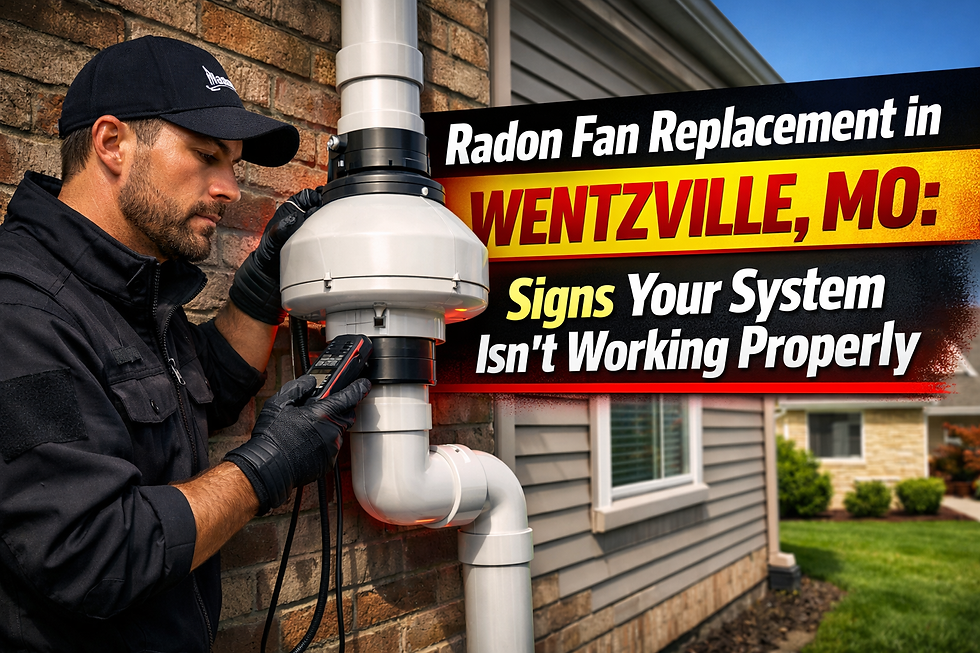
A radon system only protects a home when it is operating correctly. That is why radon fan replacement in Wentzville MO is not a minor maintenance issue. It is a performance issue tied directly to indoor air quality, real-estate timing, and whether an existing mitigation system is still doing its job.
A failed or underperforming fan can leave a home with elevated radon levels while the system still looks normal from a distance. The pipe is still there. The fan housing is still mounted. The label is still on the wall. What is missing is reliable suction and verified system performance. In many cases, proper repair requires more than swapping out one motor. It requires a diagnostic inspection of the full mitigation system.
In Wentzville, Foristell, Wright City, Lake St. Louis, and surrounding parts of St. Charles County and eastern Warren County, that distinction matters. A radon fan can fail outright, lose performance gradually, or continue running while the system itself is no longer pulling correctly.
What a Radon Fan Does in an Active Soil Depressurization System
A radon fan is the mechanical component that creates negative pressure beneath a home’s slab or beneath a crawlspace membrane in an active soil depressurization system. That negative pressure helps intercept soil gas before it enters the living space.
Bottom line: if the fan is not operating correctly, the mitigation system may no longer be controlling radon as intended.
The fan does not work in isolation. Its performance depends on the full system design, including:
suction point location
sub-slab communication
vent pipe routing
airtight slab and sump sealing
condensate management
discharge configuration
proper electrical supply
correct fan selection for the home and foundation conditions
That is why radon system repair in Wentzville MO should never be approached as a generic equipment swap.
Missouri Conditions Matter More Than Most Homeowners Realize
Radon systems in eastern Missouri operate under real environmental stress. Homes in Wentzville, O’Fallon, Lake St. Louis, Dardenne Prairie, St. Peters, St. Charles, St. Paul, Cottleville, Foristell, and Wright City see seasonal conditions that directly affect foundations, piping, and long-term system durability.
Freeze-thaw cycles matter. Seasonal expansion and contraction can stress seals, slab penetrations, and exterior mounting points.
High humidity matters. Moisture can affect condensate behavior inside vent piping, expose weak joints, and accelerate wear in poorly installed systems.
Expansive clay soils matter. Much of this region deals with soil movement and settlement pressure that can change slab conditions over time. That can alter leakage paths, change sub-slab communication, and expose weaknesses that were not fully addressed during the original install.
Snow, ice, and wind exposure matter on exterior runs. Fan brackets, couplings, discharge stability, and pipe support all need to hold up over time.
Aging housing stock matters too. In parts of St. Charles and older surrounding communities, mixed foundation types, retrofits, additions, and patched utility penetrations create conditions that are rarely identical from one house to the next. Basements, slabs, crawlspaces, and split-level foundations all present different diagnostic considerations.
Signs a Radon Fan Is Failing or the System Is Not Working Properly
A failing radon fan does not always announce itself clearly. Some systems go silent. Others get louder. Some continue running even though system performance has dropped.
Common warning signs include:
the U-tube manometer reading changes suddenly or drops to zero
the fan becomes unusually loud
new vibration is felt through the pipe or wall
the fan is humming but not pulling correctly
a recent radon test comes back high despite an existing system
a home inspection or real-estate retest raises new concerns
moisture staining appears near piping or fan connections
a previously quiet system starts rattling, buzzing, or surging
Noise alone is not a diagnosis. A noisy fan may be failing, but it may also point to mounting issues, water problems, bad pipe support, or incorrect system pressure. A quiet fan is not proof of proper operation either.
That is why the manometer matters. It is one of the fastest field indicators of whether the system vacuum has changed. It does not replace testing, but it does provide immediate diagnostic value.
Radon Fan Replacement in Wentzville MO Is Usually a Diagnostic Job First
The most common mistake in radon mitigation fan replacement is treating the fan as the only problem. In many homes, the fan is the failed part. In other homes, the fan is only the visible symptom.
A proper diagnostic visit looks at the entire pressure field and vent path. If there is suction loss from slab leakage, failed sump sealing, cracked fittings, blocked piping, improper discharge layout, or wrong fan sizing, installing a new fan without correcting the rest of the system leaves performance on the table.
Bottom line: the correct repair is the one that restores verified system function, not just fan rotation.
Common Failure Scenario: Complete Fan Failure
Why it happens
Radon fans are mechanical devices operating continuously for years. Bearings wear out. Motors fail. Moisture exposure, age, power problems, and poor installation all shorten service life.
How it worsens over time
Once the fan stops, active suction stops. The house may still have a visible mitigation system, but the system is no longer actively depressurizing beneath the slab or membrane.
What homeowners and sellers get wrong
The most common mistake is assuming the system is still working because the piping is still in place. Another mistake is waiting until a closing deadline or failed retest forces an emergency repair.
How Radon Ninjas evaluates it
Radon Ninjas checks fan operation, manometer readings, visible system condition, electrical supply, pipe integrity, and whether the original fan selection was appropriate for the system.
How Radon Ninjas repairs it
We replace the failed fan with a properly matched unit, correct related installation issues where needed, secure mounting, verify suction behavior, and identify whether follow-up testing is needed to confirm post-repair performance.
Common Failure Scenario: Noisy or Vibrating Fan
Why it happens
Fans get noisy when internal components wear, when mounting degrades, or when vibration transfers into poorly supported piping.
How it worsens over time
Noise often becomes more severe before full failure. Vibration can also loosen joints, stress couplings, and create secondary wear.
What homeowners and sellers get wrong
Many assume noise is normal as long as the fan still runs. It is not. A sudden change in sound deserves inspection.
How Radon Ninjas evaluates it
We inspect the fan, pipe support, mounting method, coupling condition, and whether vibration is a symptom of deeper performance issues.
How Radon Ninjas repairs it
We replace failing fans when required, correct support and mounting issues, and stabilize the system so it runs cleanly and predictably.
Common Failure Scenario: Fan Running but System Not Pulling Correctly
Why it happens
A fan can still spin while the system loses effectiveness from leaks, poor sealing, suction field changes, or incorrect fan selection.
How it worsens over time
The system may deliver partial performance for a while, then lose control during seasonal shifts or under changing house conditions.
What homeowners and sellers get wrong
They assume a running fan equals a working system. It does not.
How Radon Ninjas evaluates it
We review manometer readings, inspect sump sealing, slab penetration sealing, accessible cracks, fittings, discharge route, and overall system design.
How Radon Ninjas repairs it
We correct the actual source of suction loss, not just the visible symptom. That may involve fan replacement, sealing corrections, piping repair, or broader mitigation adjustments.
Need fast answers on a failing radon system?
Call: 636-336-6312
Website: RadonNinjas.com
Hire a Pro. Get It Done Right.
Common Failure Scenario: Water Intrusion and Moisture Damage
Why it happens
Condensate, poor pipe pitch, exterior exposure, and water entry around penetrations can all affect the fan and piping over time.
How it worsens over time
Moisture can damage components, stress connections, and reduce long-term system reliability.
What homeowners and sellers get wrong
They focus on the fan only and miss the reason the fan failed early.
How Radon Ninjas evaluates it
We inspect the full vent path, fan orientation, exterior exposure, condensate behavior, and moisture-related wear patterns.
How Radon Ninjas repairs it
We replace damaged components and correct the design or installation issues that allowed moisture problems to develop in the first place.
Common Failure Scenario: Failed Seals, Cracked Connections, and Bad Discharge Layout
Why it happens
Over time, sump lids loosen, slab penetrations leak, couplings crack, and poorly planned discharge layouts create avoidable performance and durability problems.
How it worsens over time
Leaks reduce vacuum efficiency. Bad discharge placement can affect long-term reliability and serviceability. Weak support leads to more movement and more failure points.
What homeowners and sellers get wrong
They replace the fan and ignore the rest of the system envelope.
How Radon Ninjas evaluates it
We inspect accessible leakage points, piping condition, discharge route, and whether the system was built for long-term performance or just initial installation speed.
How Radon Ninjas repairs it
We tighten up the system, restore integrity, improve serviceability, and verify that the repaired system is operating as intended.
Why DIY Fan Replacement and Amateur Repairs Fail
DIY radon fan replacement fails for one reason more than any other: it treats radon control like a simple mechanical swap instead of a pressure-management system.
Common DIY failures include:
installing the wrong fan for the system resistance
ignoring vacuum characteristics
missing suction loss from slab leakage or sump issues
poor electrical work
improper mounting and vibration transfer
incomplete couplings or pipe support
bad discharge placement
no verification after repair
no post-repair radon test
A spinning fan is not proof of a functioning system. A professional repair has to answer one question clearly: is the system now controlling radon properly?
How Radon Ninjas Handles a Radon Fan Replacement or Repair Call
Radon Ninjas approaches repair work in a defined sequence, not by guesswork.
1. Symptom review
We start with what changed. Noise, manometer movement, recent radon test results, real-estate timing, moisture symptoms, and system age all matter.
2. Visual inspection
We inspect the fan, piping, supports, couplings, penetrations, labels, accessible slab conditions, and visible sump conditions.
3. Manometer and vacuum review
We evaluate whether the system vacuum is consistent with expected operation and whether recent changes suggest fan failure, leakage, or broader system issues.
4. Fan and piping evaluation
We assess fan condition, model suitability, mounting integrity, vibration behavior, and vent pipe condition.
5. Leak and seal assessment
We look for failed seals at slab penetrations, sump lids, accessible cracks, and other leakage points that can reduce effective suction.
6. Discharge and electrical review
We check discharge routing, serviceability, power supply reliability, and whether electrical conditions contributed to the problem.
7. Repair execution
If replacement alone is appropriate, we perform that work correctly. If the system needs more than a fan, we address the real failure points.
8. Post-repair verification
We confirm operation after repair and recommend follow-up testing where appropriate, especially when the repair affects system performance expectations or real-estate timelines.
For homeowners in Wentzville, that process matters. So does working with a company that understands the difference between a quick part swap and actual radon mitigation service.
For broader system information, homeowners can also review the Radon Ninjas homepage and related guidance such as what to do if your radon level is still high after mitigation.
The Cost of Waiting Too Long
Delaying a failing radon fan repair creates predictable problems.
First, there is the exposure issue. A visible system can create false confidence when the system is not actually pulling correctly.
Second, delay tends to make diagnosis harder under pressure. That becomes obvious during home sales, buyer negotiations, inspection response deadlines, and post-mitigation retest scheduling.
Third, small repair problems can become broader correction jobs. A failing fan may be the first symptom of mounting issues, moisture problems, pipe leakage, or long-ignored system design flaws.
Bottom line: early diagnosis is usually cleaner, faster, and more controllable than last-minute repair under deadline.
Service Across Eastern and Central Missouri
Radon Ninjas provides radon testing, mitigation, fan replacement, and radon system repair across a wide Missouri service footprint. That includes St. Charles County, St. Louis County, Lincoln County, Warren County, Franklin County, Jefferson County, Montgomery County, and Pike County.
That regional coverage matters for homeowners, real-estate professionals, property managers, and buyers who need a company that can respond across Wentzville, Foristell, Wright City, Lake St. Louis, O’Fallon, St. Peters, and the surrounding corridor without treating every house like the same system.
Trust Signals That Matter in Health-Critical Work
When a homeowner or agent is choosing a radon contractor, trust comes from consistency. Google Reviews, Facebook Reviews, and Yelp Reviews help show whether a company communicates clearly, shows up professionally, and handles technical service work with discipline.
For radon repair and mitigation, that matters more than branding language. The work has to be clean, verifiable, and dependable.
FAQ: Radon Fan Replacement and System Repair in Missouri
How do I know if my radon fan needs replacement in Wentzville, MO?
A failed or failing fan often shows up as a changed U-tube manometer reading, unusual noise, vibration, or a high radon test despite an existing system. The most reliable approach is a diagnostic inspection that checks fan operation, piping condition, suction behavior, and related system issues before replacement.
Can a radon fan run and still not be working properly?
Yes. A radon fan can still spin while the system loses effectiveness from air leaks, failed sealing, bad fan sizing, moisture issues, or reduced sub-slab communication. A running fan is not proof of proper radon control. System performance has to be evaluated, not assumed.
How long does a radon fan replacement take?
A straightforward radon mitigation fan replacement is often completed in a single service visit. The actual time depends on access, fan location, electrical conditions, mounting corrections, pipe repairs, and whether the system needs broader diagnostic or sealing work beyond the fan itself.
Should I retest after replacing a radon fan?
Yes. Post-repair retesting is the cleanest way to confirm that the system is controlling radon properly after replacement. This is especially important when a home sale is involved, when recent radon results were elevated, or when the system showed signs of broader performance problems.
Can a failed radon fan delay a home sale in Missouri?
Yes. A failed fan can lead to elevated radon test results, failed repair negotiations, delayed closing timelines, and rushed last-minute service decisions. In real-estate transactions, radon system condition matters because buyers, sellers, and agents need confidence that the mitigation system is functioning correctly.
What causes radon systems to fail in eastern Missouri homes?
Common causes include fan age, moisture exposure, poor initial fan sizing, slab or sump leakage, cracked fittings, power supply issues, settlement-related changes, and long-term wear from Missouri freeze-thaw and seasonal moisture conditions. Mixed foundation types also make some homes more complex to diagnose and repair.
Is a loud radon fan always a sign it needs replacement?
Not always, but it should never be ignored. Loud noise can indicate bearing wear, vibration transfer, bad mounting, pipe support issues, or moisture-related stress. The right response is diagnosis first, then targeted repair or replacement based on actual system condition.
What is the difference between fan replacement and full radon system repair?
Fan replacement addresses one mechanical component. Full radon system repair addresses the broader performance of the mitigation system, including leaks, sealing, piping, discharge layout, fan sizing, electrical issues, and post-repair verification. In many homes, proper repair requires both.
Schedule Radon Fan Replacement or Diagnostic Service
If your system is noisy, your manometer reading changed, your radon fan stopped working, or a real-estate test raised concerns, now is the time to address it. Radon Ninjas provides radon fan replacement, radon mitigation repair, diagnostic inspections, and testing across St. Charles County, St. Louis County, Lincoln County, Warren County, Franklin County, Jefferson County, Montgomery County, and Pike County.
Book service at RadonNinjas.com or call 636-336-6312. If your system is not pulling correctly, waiting only increases exposure risk, compresses repair timelines, and makes closing-related decisions harder. Get the system inspected, repaired correctly, and verified.

Comments